Soft skills every leader needs in 2026 (and why we call them Power Skills)
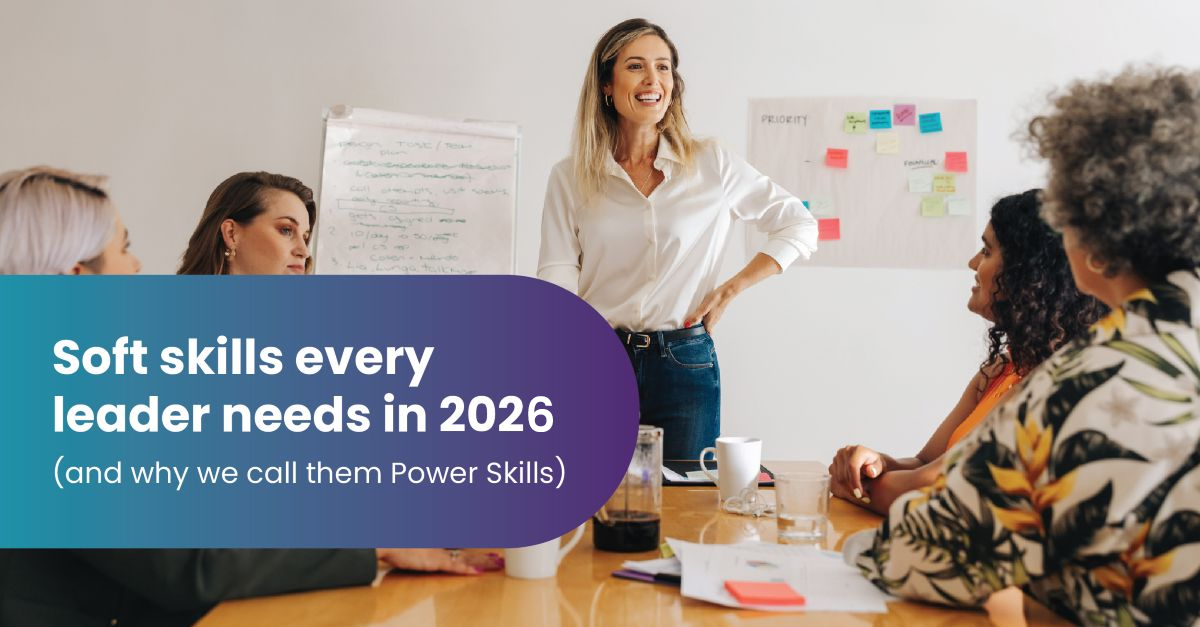
Power Skills every leader needs in 2026
(and why we call them Power Skills)
Technical expertise will get you into leadership.
But it’s rarely what determines success once you’re there.
In 2026, leaders are operating in environments shaped by AI, hybrid teams, rapid change and constant pressure to deliver results. The organisations that perform best are led by people who combine technical knowledge with strong human capabilities.
These are often called soft skills.
But there’s nothing soft about them.
At Power Skills, we call them Power Skills because they are the capabilities that enable leaders to influence, align and move people toward outcomes.
And in many organisations, they are the difference between projects that stall and teams that deliver.
Why Power Skills matter even more in 2026
Technology continues to transform how organisations operate. AI, automation and digital tools are now embedded in everyday workflows.
But the reality is simple: technology doesn’t lead teams — people do.
That means the leaders who stand out are those who can:
-
communicate clearly
-
build trust and alignment
-
guide teams through uncertainty
-
resolve conflict and maintain momentum
Research consistently shows that skills such as communication, problem solving, teamwork and emotional intelligence remain among the most valued capabilities in modern workplaces.
As organisations adopt AI and new technologies, these human capabilities become even more important.
The Power Skills every leader needs in 2026
1. Communication that creates clarity
Leaders spend a significant amount of time communicating — yet communication breakdown remains one of the most common causes of project failure.
Strong leaders know how to:
-
explain complex ideas clearly
-
align teams around priorities
-
deliver constructive feedback
-
listen actively
Communication isn’t simply about talking. It’s about ensuring people understand what matters, why it matters and what needs to happen next.
2. Emotional intelligence
Emotional intelligence is the ability to recognise, understand and manage both your own emotions and those of others.
Leaders with strong emotional intelligence:
-
build stronger relationships
-
handle conflict effectively
-
create psychological safety within teams
Research shows emotional intelligence plays a major role in leadership effectiveness and team engagement.
In high-pressure environments, this capability becomes critical.
3. Decision-making under pressure
Leaders rarely have perfect information.
Projects move quickly. Stakeholders have competing priorities. And the cost of delay can be significant.
Effective leaders are able to:
-
assess risk
-
balance competing perspectives
-
make decisions with confidence
Strong decision-making helps organisations maintain momentum even when conditions are uncertain.
4. Adaptability
Change is now constant.
Whether driven by technology, regulation or market conditions, leaders are expected to guide their teams through ongoing transformation.
Adaptable leaders:
-
adjust quickly to new conditions
-
remain open to new ideas
-
encourage continuous learning
Adaptability has become one of the most sought-after leadership capabilities as workplaces evolve.
5. Collaboration and influence
Leadership is rarely about authority alone.
The most effective leaders know how to:
-
influence without formal control
-
build alignment across teams
-
bring different perspectives together
Strong collaboration helps organisations solve complex problems faster and deliver stronger outcomes.
Why we call them Power Skills
The term soft skills suggests these capabilities are optional.
They are not.
These skills determine how effectively leaders can guide teams, resolve challenges and deliver results.
That’s why we call them Power Skills — because they power leadership effectiveness.
Building Power Skills
Like any capability, Power Skills can be developed with the right training and practice.
Organisations that invest in these capabilities see stronger leadership, better collaboration and improved delivery outcomes.
For individuals, developing Power Skills can accelerate career growth and increase leadership effectiveness.
FAQs
Q: Why call them Power Skills instead of soft skills?
Because these capabilities directly power leadership effectiveness and business outcomes.
Q: Can Power Skills be taught?
Yes. With structured training and practice, leaders can significantly improve.
Q: What courses support Power Skills for leaders?
Courses such as Building and leading a team and Communicating with impact directly build these skills.
Conclusion
In 2026, leadership is about more than technical know-how. It is about Power Skills — the capabilities that build trust, influence, and collaboration. Leaders who invest in these skills will be best placed to succeed in an uncertain future.
👉 Explore our leadership courses to build the Power Skills every leader needs in 2026.